Fiber vs MOPA Laser for Black Marking on Stainless Steel
Last updated: September 22, 2026
Short answer
A conventional Q-switched fiber laser can be a practical starting point for black or dark marking on suitable stainless steel. A MOPA fiber laser adds a broader pulse-control window, which can make it easier to tune appearance, heat input and process stability for demanding black-marking work. MOPA is not automatically darker, faster or better.
Choose between them by testing the same stainless-steel grade and finish with the real artwork, lens and acceptance method. Results depend on alloy, surface condition, laser source, pulse behavior, field lens, focus, scan strategy and required cycle time.
Define “black marking” before choosing the source
“Black mark” can describe different surface results. One buyer may need a smooth, high-contrast identification mark with minimal measurable removal. Another may accept shallow texture, while a third needs engraved depth and happens to want the result to look dark.
On stainless steel, a dark mark can involve an annealing- or oxidation-type surface change, controlled melting or microstructural change, or a combination of effects. The dominant mechanism and final appearance vary with the material and process. It is therefore safer to specify the accepted surface, depth, contrast and durability than to order a machine from the word “black” alone.
Before testing, state whether the priority is:
- a smooth dark surface mark;
- a machine-readable black code;
- a controlled gray-to-black appearance;
- a repeatable color effect;
- shallow etching;
- material-removing engraving;
- minimum heat effect or distortion;
- resistance to cleaning, abrasion or the actual service environment.
Black surface marking and deep engraving are different acceptance targets. Do not compare them only by visual darkness.
Standard Q-switched fiber vs MOPA fiber
A MOPA marking source is itself a fiber laser. In purchasing discussions, “standard fiber vs MOPA” normally compares a conventional Q-switched pulsed fiber source with a MOPA source that offers a broader adjustable pulse-width range.
| Decision factor | Standard Q-switched fiber | MOPA fiber |
|---|---|---|
| Routine stainless-steel identification | Practical first trial for logos, text, serial numbers and codes | Also suitable, but the extra adjustment range may not be necessary |
| Pulse-width control | Commonly fixed or available over a narrower source-specific range | Broader source-specific pulse-width adjustment |
| Frequency flexibility | Frequency is adjustable within the source limits, with pulse behavior linked to the source design | Often provides a wider usable combination of pulse width and frequency; verify the exact source model |
| Black surface effect | Can produce a useful dark or black result on suitable material and finish | Worth comparing when a wider tuning window is needed for darkness, heat control or repeatability |
| Heat input | Can meet the requirement when the tested recipe is stable | Additional pulse control can help tune the thermal interaction, but does not guarantee lower total heat in every recipe |
| Color effects | A limited color window may be possible on some stainless steel | Commonly evaluated when controlled stainless-steel color effects are part of the requirement |
| Engraving | Strong option for routine metal engraving when depth, edge quality and cycle are proven | Also capable; pulse control can help tune edge condition and heat, but depth and speed still require testing |
| Speed | May be the simpler or faster validated process for routine identification | May widen the process window or improve a difficult result, but is not universally faster |
| Parameter sensitivity | Fewer pulse variables can simplify recipe development | More adjustment creates more test combinations and demands disciplined recipe control |
| Best reason to choose it | The simpler source already passes contrast, durability, readability and cycle requirements | Testing proves that broader pulse control improves the required result or production window |
Exact pulse-width and frequency ranges are source-specific. Record the full source model in the quotation and in every approved sample record.
How pulse width and frequency affect the process
Pulse width changes how laser energy is delivered in time. Repetition frequency changes how often pulses arrive. Together with average power, scan speed, hatch spacing, focus and number of passes, these settings influence peak power, pulse energy, thermal accumulation and material removal.
That interaction is why a settings table copied from another machine is not a production recipe. Two “30W MOPA” sources can have different allowable pulse-width and frequency combinations. A different field lens, spot condition, stainless grade or brushed finish can also change the result.
Pulse width
Broader pulse-width control gives a process engineer another way to tune surface interaction. A shorter or longer pulse is not inherently better: the useful setting depends on whether the acceptance target is a smooth dark mark, a color effect, limited heat, fine detail or material removal.
Frequency
Changing frequency can alter pulse energy and the way successive pulses overlap thermally. The available frequency range can also change with the selected pulse width. Evaluate valid source combinations rather than treating the controls as independent unlimited values.
Scan speed, hatch and passes
Scan speed and hatch spacing determine how energy is distributed across the artwork. Filled black areas, small code cells and thin text do not behave like a single outline. Multiple passes can darken or deepen a mark, but they also change cycle time and heat input. Record the entire recipe.
Focus and field lens
Focus position and spot performance are part of the process. A lens selected for a larger field can change spot size and energy density. Test the exact lens and field that will be supplied, especially when the mark contains small text or a 2D code. See the laser marking field-size guide before approving the optics.
When conventional fiber is the better starting point
Start with a conventional Q-switched fiber trial when:
- the job is routine text, logos, serial numbers or codes on stainless steel;
- the accepted result does not require a tightly controlled color effect;
- the standard source already achieves the required darkness and durability;
- a straightforward recipe and production handoff are important;
- the buying decision prioritizes a proven result rather than the largest parameter range.
If the conventional source passes the same acceptance test at the required complete cycle time, MOPA should not be recommended only because it has more settings.
When MOPA is worth comparing
Compare a MOPA source when:
- a deep-looking black surface effect is difficult to stabilize with the standard source;
- the approved appearance has a narrow process window;
- a color effect on controlled stainless steel is required;
- thin or heat-sensitive parts need more process-development options;
- edge condition around fine text or codes is important;
- tests show that pulse-width control improves repeatability across representative parts.
These are reasons to test MOPA, not guarantees of success. The exact alloy, finish, cleaning method and part geometry remain part of the result.
Black marking, annealing-type effects and engraving
Black surface marking
The goal is normally strong visual contrast with little or no specified depth. The approved sample should define blackness or contrast under controlled viewing conditions, surface texture, code readability and permitted heat effect.
Annealing- or oxidation-type effects
Heating can create a dark oxide or related surface appearance on suitable stainless steel. The result depends on grade, finish, surface preparation and process conditions. If corrosion performance or a regulated downstream process matters, validate the completed marked part under the applicable customer or industry procedure; do not infer it from appearance alone.
Color marking
Color effects can arise from controlled surface and oxide conditions. MOPA is commonly evaluated because its pulse control provides more tuning options. A requested shade is not guaranteed without a defined material, controlled surface and approved production sample.
Engraving
Engraving removes material to create depth. Judge it by depth, edge quality, heat-affected area, debris, cycle time and any downstream finishing requirement. A dark surface mark and a deep engraving should be quoted as separate jobs when both are needed.
Material and surface variables that change the result
Do not approve a process from the general label “stainless steel.” Record:
- exact grade and supplier where available;
- brushed, polished, bead-blasted, coated or other finish;
- direction and consistency of the finish;
- oil, oxide, residue and cleaning method;
- part thickness and heat sensitivity;
- flat, curved, recessed or irregular geometry;
- batch-to-batch variation;
- required inspection lighting and viewing angle.
A recipe approved on polished 304 should not be assumed to produce the same blackness on brushed 316L or on a coated part.
Run a fair source comparison
Use the same controlled test plan for both sources:
- Use representative production parts from more than one expected batch when variation matters.
- Use the real artwork, including the smallest text or code cell.
- Keep the field lens, artwork position, fixture and inspection method comparable unless the test intentionally changes one variable.
- Record the exact source model, rated power, pulse width, frequency, power setting, speed, hatch, passes, focus and field.
- Measure complete cycle time, including loading, positioning and inspection.
- Inspect darkness or contrast, code readability, surface texture, depth where specified, edge quality and heat effect.
- Apply the real durability, cleaning or environmental test when it belongs to the product requirement.
- Keep a labeled reference sample and the approved recipe.
Do not select a winner from a photograph taken under different lighting or from one unrecorded parameter trial.
Speed and production stability
Neither source is always faster. A conventional fiber source may complete a routine identification mark with a simple, stable recipe. A MOPA source may reach a difficult appearance with a wider process window, or it may require more development and a slower recipe. Artwork fill, lens, field, hatch, passes, source limits and inspection all affect output.
Compare:
- laser-on time;
- loading and positioning time;
- first-piece setup time;
- inspection or code-verification time;
- accepted parts per hour;
- stability after material or batch changes.
Accepted output is a better buying metric than nominal scan speed.
Configure the machine around the approved process
After the source comparison, confirm the workstation and supplied equipment:
- lens and marking field;
- working distance and Z-axis or column clearance;
- fixture or rotary device;
- open or enclosed workstation;
- extraction and process debris control;
- controller, software and variable-data workflow;
- code verification or vision requirement;
- electrical supply and installation space;
- sample report and itemized quotation.
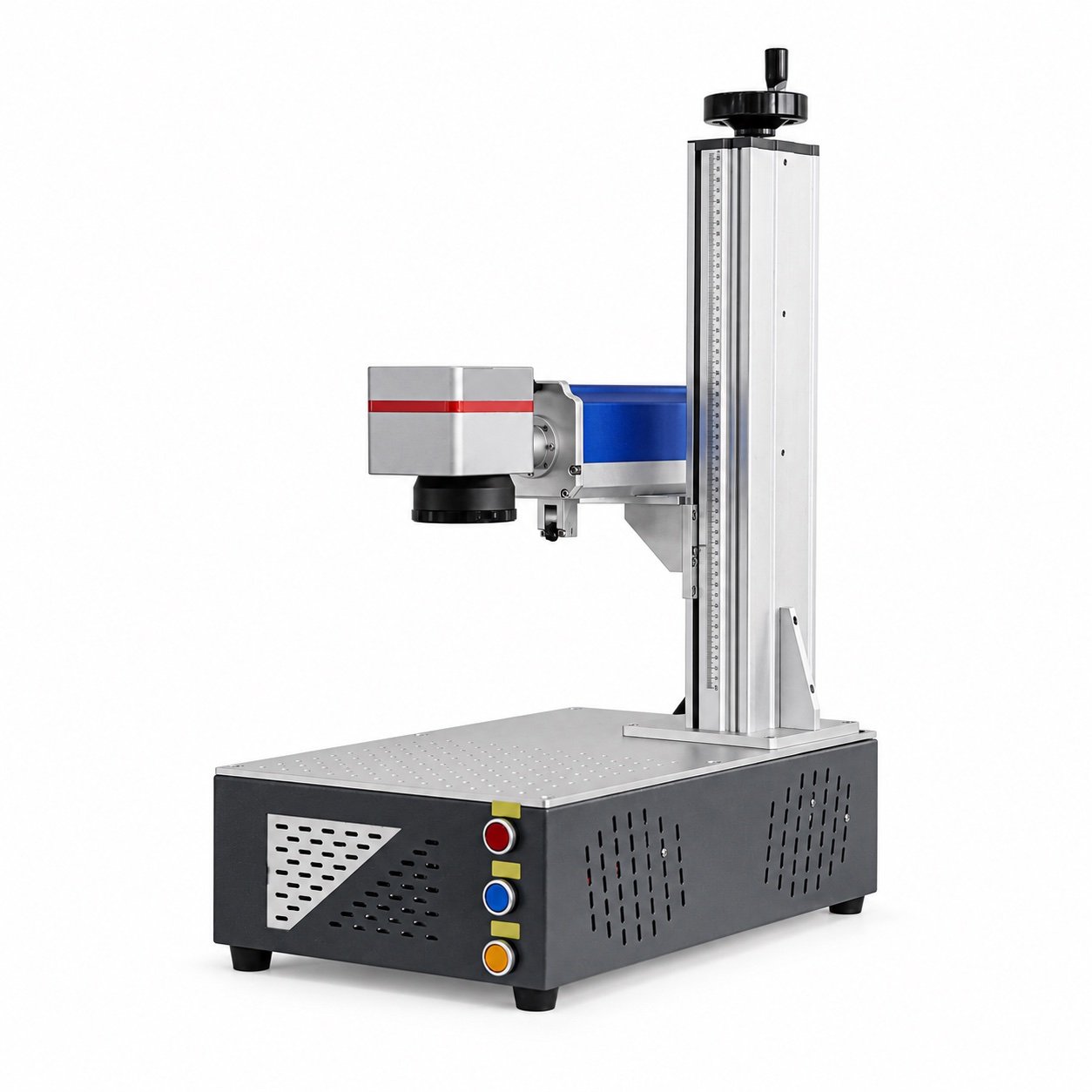
The FY-LMM02 desktop laser marking and engraving machine is an integrated, manually loaded platform that can be configured after the application is reviewed. Its public page does not promise that every conventional fiber or MOPA source, power or lens combination is available. Request confirmation for the exact quoted configuration.
For other loading methods, compare all FYXFER laser marking machine formats.
Frequently asked questions
Can a standard fiber laser make a black mark on stainless steel?
It can produce a dark or black result on suitable stainless steel when the source, lens, focus and process are matched to the grade and finish. Test the real part and define the accepted darkness, surface condition, durability and cycle time.
Is MOPA always better for stainless-steel black marking?
No. MOPA provides broader pulse-control options, which can help on demanding appearance or heat-sensitive work. A conventional Q-switched fiber source remains a practical choice when it already passes the required sample and production test.
Does black marking remove material?
Some black surface processes aim for minimal removal and create contrast through an annealing-, oxidation- or related surface effect. Other dark marks include melting, texture or shallow removal. Specify and measure the allowed depth and surface condition instead of relying on the word “black.”
Can I copy black-marking parameters from another machine?
Use published settings only as a test starting point, never as a guaranteed recipe. Source model, pulse behavior, lens, spot condition, material grade, finish, focus, artwork and hatch can all change the result.
Is MOPA required for color marking on stainless steel?
MOPA is commonly evaluated because adjustable pulse width provides more control over the process window. The achievable shade and repeatability still depend on the exact stainless steel, surface preparation, lens and full recipe. Approve a controlled sample rather than assuming a color from the source name.
Which source is faster?
There is no universal winner. Compare the accepted result at the complete production cycle, including loading, marking, inspection and rejects. Standard fiber may be simpler for routine identification; MOPA may improve a difficult process when its added control produces a stable result.
Request a stainless-steel black-marking comparison
Send the stainless-steel grade and finish, part photograph or drawing, artwork, marked area, smallest feature, required darkness or depth, durability test, production quantity and target cycle time.
Review the broader Fiber vs MOPA laser guide, the stainless-steel marking selection guide and MOPA laser marking machines before choosing the source.